
Wrote, researched and interviewed the public for feature articles in Nuance Magazine, The
New Straits Times Sunday pullout.
Lo nak pergi ke mana malam ni?
Ngedate.
Lo nak keluar sama gue nggak?
Lainlah kalau lo tu Rangga.
The conversation is not in Bahasa Malaysia, but if you thought it took place in Indonesia, think again. It is how pimply, gangly teens and even 20-somethings in Kuala Lumpur are talking after watching the latest boy-meets-girl-fall-in-love movie — courtesy of Jakarta.
It could be an exchange of mobile phone text messages too. Guy asks girl for a date, she turns him down. She adds “It’s not like you’re Rangga”, crushing the wretch with an unfair comparison with the movie’s brooding teen hero.
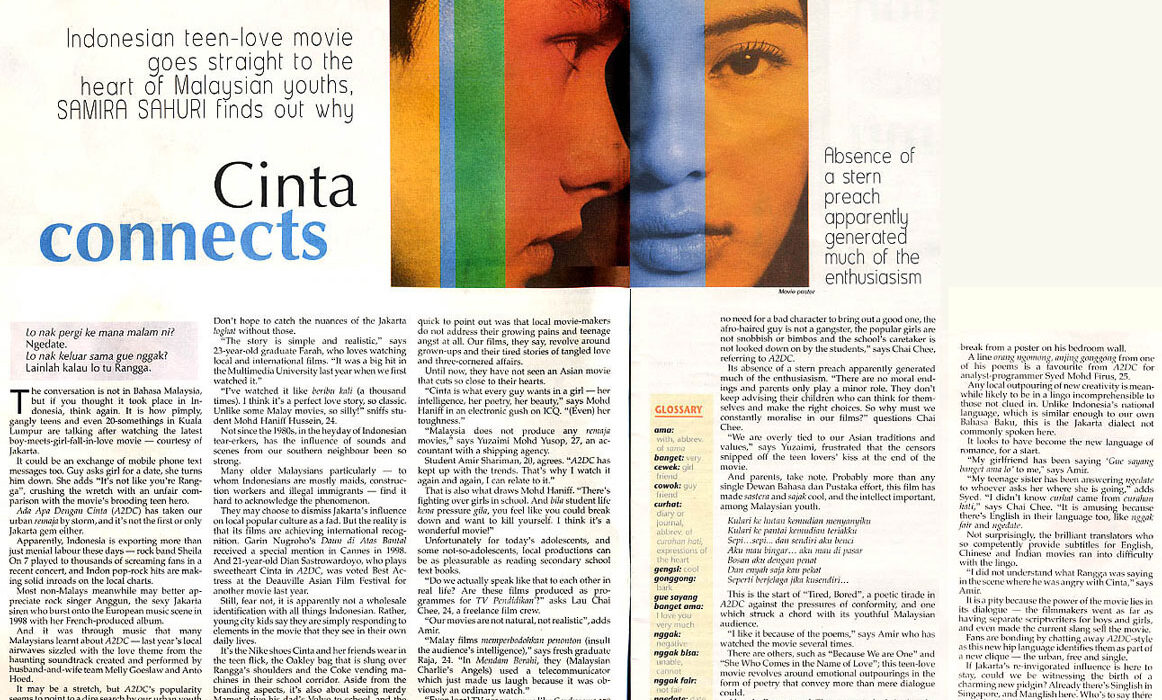
Ada Apa Dengan Cinta (A2DC) has taken our urban remaja by storm, and it’s not the first or only Jakarta gem either.
Apparently, Indonesia is exporting more than just menial labour these days — rock band Sheila On 7 played to thousands of screaming fans in a recent concert, and Indon pop-rock hits are making solid inroads on the local charts.
Most non-Malays meanwhile may better appreciate rock singer Anggun, the sexy Jakarta siren who burst onto the European music scene in 1998 with her French-produced album.
And it was through music that many Malaysians learnt about A2DC — last year’s local airwaves sizzled with the love theme from the haunting soundtrack created and performed by husband-and-wife team Melly Goeslaw and Anto Hoed.
It may be a stretch, but A2DC’s popularity seems to point to a dire search by our urban youth for something to relate to. Students and young graduates alike struggled through pirated copies of A2DC without Bahasa Malaysia subtitles. Don’t hope to catch the nuances of the Jakarta loghat without those.
“The story is simple and realistic,” says 23-year-old graduate Farah, who loves watching local and international films. “It was a big hit in the Multimedia University last year when we first watched it.”
“I’ve watched it like beribu kali (a thousand times). I think it’s a perfect love story, so classic. Unlike some Malay movies, so silly!” sniffs student Mohd Haniff Hussein, 24.
Not since the 1980s, in the heyday of Indonesian tear-jerkers, has the influence of sounds and scenes from our southern neighbour been so strong.
Many older Malaysians particularly — to whom Indonesians are mostly maids, construction workers and illegal immigrants — find it hard to acknowledge the phenomenon.
They may choose to dismiss Jakarta’s influence on local popular culture as a fad. But the reality is that its films are achieving international recognition. Garin Nugroho’s Daun di Atas Bantal received a special mention in Cannes in 1998. And 21-year-old Dian Sastrowardoyo, who plays sweetheart Cinta in A2DC, was voted Best Actress at the Deauville Asian Film Festival for another movie last year.
Still, fear not, it is apparently not a wholesale identification with all things Indonesian. Rather, young city kids say they are simply responding to elements in the movie that they see in their own daily lives.
It’s the Nike shoes Cinta and her friends wear in the teen flick, the Oakley bag that is slung over Rangga’s shoulders and the Coke vending machines in their school corridor. Aside from the branding aspects, it’s also about seeing nerdy Mamet drive his dad’s Volvo to school, and the meeting up after school to go for a pop-rock concert.
One thing which these street-wise youths were quick to point out was that local movie-makers do not address their growing pains and teenage angst at all. Our films, they say, revolve around grown-ups and their tired stories of tangled love and three-cornered affairs.
Until now, they have not seen an Asian movie that cuts so close to their hearts.
“Cinta is what every guy wants in a girl — her intelligence, her poetry, her beauty,” says Mohd Haniff in an electronic gush on ICQ. “(Even) her toughness.”
“Malaysia does not produce any remaja movies,” says Yuzaimi Mohd Yusop, 27, an accountant with a shipping agency.
Student Amir Shariman, 20, agrees. “A2DC has kept up with the trends. That’s why I watch it again and again, I can relate to it.”
That is also what draws Mohd Haniff. “There’s fighting over girls in school. And bila student life kena pressure gila, you feel like you could break down and want to kill yourself. I think it’s a wonderful movie!”
Unfortunately for today’s adolescents, and some not-so-adolescents, local productions can be as pleasurable as reading secondary school text books.
“Do we actually speak like that to each other in real life? Are these films produced as programmes for TV Pendidikan’?” asks Lau Chai Chee, 24, a freelance film crew.
“Our movies are not natural, not realistic”, adds Amir.
“Malay films memperbodohkan penonton (insult the audience’s intelligence),” says fresh graduate Raja, 24. “In Mendam Berahi, they (Malaysian Charlie’s Angels) used a telecommunicator which just made us laugh because it was obviously an ordinary watch.”
“Even local TV programmes like Cerekarama are better than our films as they are more realistic and true to everyday life,” echoes Farah.
“There are no stereotyped characters. There is no need for a bad character to bring out a good one, the afro-haired guy is not a gangster, the popular girls are not snobbish or bimbos and the school’s caretaker is not looked down on by the students,” says Chai Chee, referring to A2DC.
Its absence of a stern preach apparently generated much of the enthusiasism. “There are no moral endings and parents only play a minor role. They don’t keep advising their children who can think for themselves and make the right choices. So why must we constantly moralise in our films?” questions Chai Chee.
“We are overly tied to our Asian traditions and values,” says Yuzaimi, frustrated that the censors snipped off the teen lovers’ kiss at the end of the movie.
And parents, take note. Probably more than any single Dewan Bahasa dan Pustaka effort, this film has made sastera and sajak cool, and the intellect important, among Malaysian youth.
Kulari ke hutan kemudian menyanyiku
Kulari ke pantai kemudian teriakku
Sepi…sepi… dan sendiri aku benci
Aku mau bingar… aku mau di pasar
Bosan aku dengan penat
Dan enyah saja kau pekat
Seperti berjelaga jika kusendiri…
This is the start of “Tired, Bored”, a poetic tirade in A2DC against the pressures of conformity, and one which struck a chord with its youthful Malaysian audience.
“I like it because of the poems,” says Amir who has watched the movie several times.
There are others, such as “Because We are One” and “She Who Comes in the Name of Love”; this teen-love movie revolves around emotional outpourings in the form of poetry that convey more than mere dialogue could.
Already Rangga and Cinta seem to be bringing the poetry of Indonesia’s James Dean, Chairil Anwar, back into fashion. The moody rebel-poet, who died when he was 27, bears mute witness to Rangga’s heartbreak from a poster on his bedroom wall.
A line orang ngomong, anjing gonggong from one of his poems is a favourite from A2DC for analyst-programmer Syed Mohd Firus, 25.
Any local outpouring of new creativity is meanwhile likely to be in a lingo incomprehensible to those not clued in. Unlike Indonesia’s national language, which is similar enough to our own Bahasa Baku, this is the Jakarta dialect not commonly spoken here.
It looks to have become the new language of romance, for a start.
“My girlfriend has been saying ‘Gue sayang banget ama lo’ to me,” says Amir.
“My teenage sister has been answering ngedate to whoever asks her where she is going,” adds Syed. “I didn’t know curhat came from curahan hati,” says Chai Chee. “It is amusing because there’s English in their language too, like nggak fair and ngedate.
Not surprisingly, the brilliant translators who so competently provide subtitles for English, Chinese and Indian movies ran into difficulty with the lingo.
“I did not understand what Rangga was saying in the scene where he was angry with Cinta,” says Amir.
It is a pity because the power of the movie lies in its dialogue — the filmmakers went as far as having separate scriptwriters for boys and girls, and even made the current slang sell the movie.
Fans are bonding by chatting away A2DC-style as this new hip language identifies them as part of a new clique — the urban, free and single.
If Jakarta’s re-invigorated influence is here to stay, could we be witnessing the birth of a charming new pidgin? Already there’s Singlish in Singapore, and Manglish here. Who’s to say there won’t be Malakarta.
So consider catching A2DC — with subtitles — before it ends its run on Feb 15.
Lo juga boleh gengsi!
GLOSSARY
ama: with, abbrev. of sama
banget: very
cewek: girl friend
cowok: guy friend
curhat: diary or journal,
abbrev. of curahan hati,
expressions of the heart
gengsi: cool
gonggong: bark
gue sayang banget ama lo:
I love you very much
nggak: negative
nggak bisa: unable,
cannot
nggak fair: not fair
ngedate: date
ngomong: speak
